


ERP Software and Points to Consider


How Should a Business's Needs Be Determined When Selecting an ERP System?
Before selecting ERP software, the business's current operations, needs, and future goals should be analyzed in detail. Since every business has different areas of activity, number of employees, business volume, and management processes, the ERP software to be used must also be suitable for these needs. Software selected without conducting a proper needs analysis may fail to meet some of the business's requirements or create additional costs due to unnecessary features. When determining a business's needs, its existing business processes should first be evaluated. The working methods of departments such as inventory management, order management, sales, purchasing, accounting, finance, and customer relations should be examined. It should be identified which operations are performed manually, which processes cause time loss, and which areas require automation.
The following points should be considered when conducting a needs analysis:
Analysis of Existing Business Processes: The daily activities of the business should be examined to determine which operations take more time and which processes need improvement.
Identifying Departmental Needs: The needs of departments such as accounting, sales, inventory, purchasing, and production should be evaluated separately. This helps ensure that the ERP system is suitable for the working structure of different departments.
Identifying Manual Operations: Processes carried out through Excel spreadsheets or different software programs should be identified. Repetitive data entry and processes requiring manual tracking should be planned to be managed through the ERP system.
Identifying Integration Requirements: Integration needs should be determined by evaluating the accounting programs, e-commerce platforms, payment systems, and other applications currently used by the business.
Evaluating Future Goals: The business's expectations, such as growth plans, opening new branches, increasing product variety, or expanding sales channels, should be taken into consideration.
Determining the Budget and Number of Users: The number of employees who will use the ERP system, the required modules, and the budget the business can allocate for the software should be planned in advance. Once the needs analysis is completed, ERP software options that match the business's priorities should be compared. The processes supported by the software, which features require additional modules, and how it works with existing systems should be evaluated.
What Are the Essential Features an ERP Software Should Have?
For ERP software to meet the needs of businesses, it must have comprehensive, flexible, and interconnected features. ERP systems, which simplify the daily operations of businesses, enable transactions across different departments to be managed through a single platform, data to be collected in a centralized structure, and business processes to be carried out more efficiently.
The essential features that an ERP software should include are as follows:
Inventory and Warehouse Management: It should enable product entries and exits to be tracked, inventory quantities to be controlled, and warehouse movements to be managed systematically.
Order and Sales Management: It should allow customer orders to be created, tracked, approved, and delivery processes to be managed.
Accounting and Financial Management: It should support the control of financial activities such as income and expense tracking, current account transactions, payment, and collection processes.
Purchasing Management: It should enable supplier information, purchase requests, orders, and product costs to be tracked.
Customer and Supplier Management: It should help store customer and supplier information in a centralized system and allow past transactions to be viewed easily.
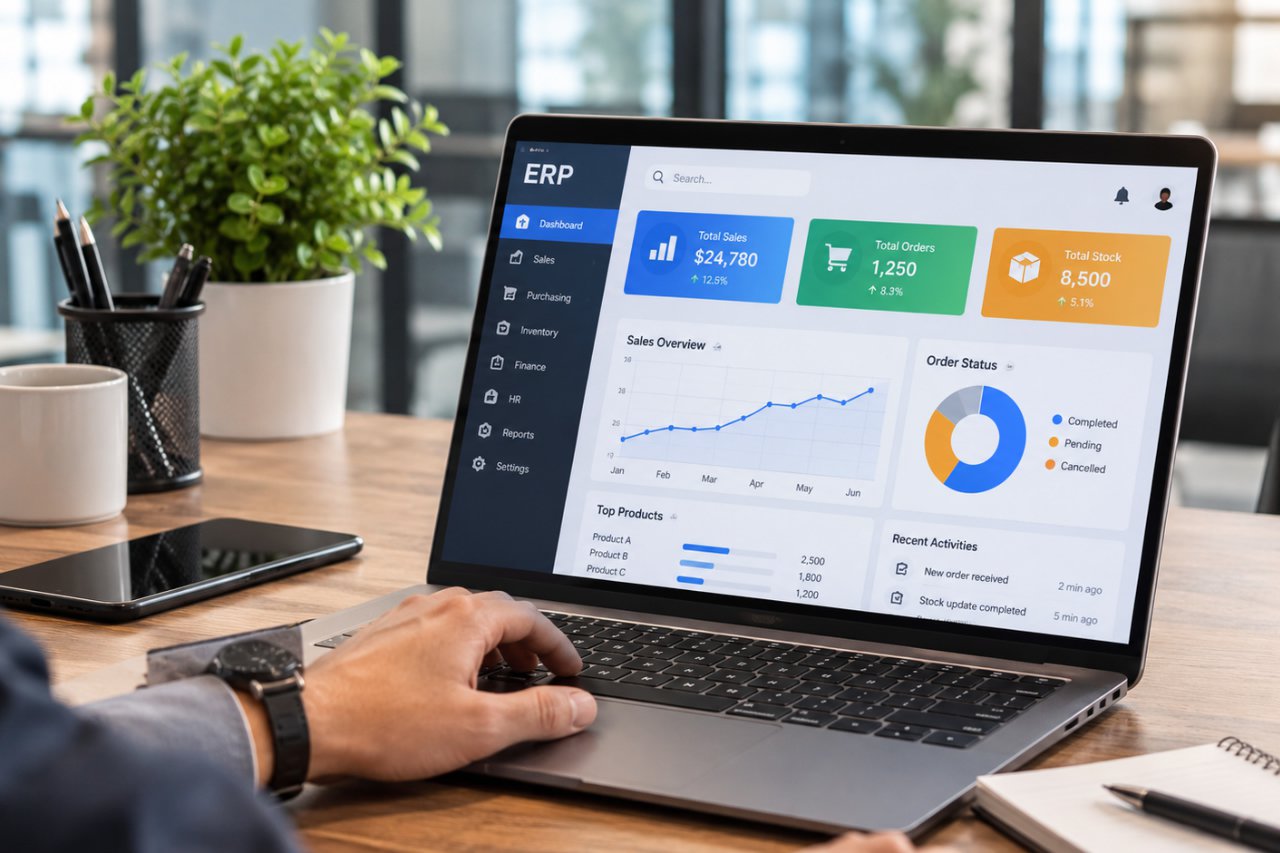
Reporting and Analysis: It should enable businesses to evaluate their performance by providing reports on sales, inventory, finance, and operational data.
User Authorization: It should allow system access permissions to be determined according to employees' duties and responsibilities.
Integration Support: It should be able to exchange data with e-commerce platforms, accounting programs, payment systems, and other business software.
Automation Features: It should support the automatic execution of repetitive operations, reducing manual workload and transaction errors.
Data Security and Backup: It should have the necessary security features to protect important business data, back it up regularly, and safeguard it against unauthorized access.
What Should Be Considered When Choosing ERP Software?
The Business's Needs Should Be Identified Correctly
Before selecting ERP software, the business should determine which processes it wants to digitalize. Requirements such as inventory tracking, order management, accounting, sales, purchasing, or production should be evaluated. By analyzing the business's current operations, it should be determined which processes require automation. This helps prevent choosing software that contains unnecessary modules or fails to meet the business's needs.
The Modular Structure of the Software Should Be Examined
The modular structure of ERP software provides significant advantages for businesses. Thanks to modular systems, businesses can use only the features they need and add new modules over time. For example, a business that initially needs inventory and order management can also integrate accounting, production, or human resources modules into the system in the future. This makes it easier for the software to adapt to the business's growth.
Ease of Use and Interface Design Should Be Evaluated
Having comprehensive features alone is not sufficient for ERP software. It is also important that employees can learn the system easily and perform their daily operations comfortably. Software with complex interfaces may make it difficult for employees to adapt to the system. Therefore, ERP software with a simple, clear, and user-friendly interface should be preferred.
Integration with Existing Systems Should Be Available
Businesses generally use accounting programs, e-commerce platforms, virtual POS systems, cargo companies, and various other software applications. The ability of the selected ERP system to integrate with these applications ensures that business processes are carried out more efficiently. Through integration, information can be transferred between data stored in different systems. This helps reduce errors caused by manual data entry and enables operations to be performed more quickly.
Data Security and Authorization Features Should Be Checked
ERP software contains important information related to businesses' financial data, customer records, employee information, and commercial activities. Therefore, data security is one of the key issues to consider when selecting software. Features such as user authorization, access control, data backup, and secure connections should be examined. In addition, it should be evaluated whether the software can be used in compliance with the current legislation on personal data protection, particularly the provisions of the Personal Data Protection Law (KVKK).
A Cloud-Based or On-Premises ERP System Should Be Selected
ERP software can generally be offered through different deployment models, such as cloud-based and on-premises systems. Cloud-based ERP systems provide access through an internet connection. This allows employees to access the system from different locations. In on-premises ERP systems, however, the software runs on the business's own server infrastructure. The appropriate model should be selected by evaluating the business's technical infrastructure, security policies, budget, and remote working requirements.
Technical Support and Training Services Should Be Provided
After purchasing ERP software, installation, usage, and technical support processes also become important. Resolving problems that may arise during use quickly helps prevent interruptions to business operations. The software provider's technical support services, training opportunities, support hours, and problem-solving processes should be examined in advance. In addition, providing training support to help new employees adapt to the system is also an advantage.
Reporting and Analysis Features Should Be Available
ERP software should not only support the management of daily operations but also help evaluate business performance. The ability to generate reports on various topics, such as sales reports, inventory movements, income and expense information, order statuses, and financial data, helps businesses make more accurate decisions. Thanks to reports based on real-time or up-to-date data, businesses can monitor their current situation, identify potential problems earlier, and make more informed plans for future periods.
The Software Should Be Scalable
The needs of businesses may change over time. An increase in the number of employees, the opening of new branches, the expansion of product variety, or an increase in sales volume may affect the capacity of the ERP system being used. Therefore, it is important that the selected software has an infrastructure capable of adapting to the business's future growth goals. Being able to easily add new users, modules, and business processes to the system provides an advantage in the long term.
The Cost and Licensing Model of the ERP Software Should Be Compared
When selecting ERP software, attention should not be focused solely on the initial purchase or subscription fee. Installation, training, integration, maintenance, technical support, and additional module costs should also be evaluated. Some ERP systems charge according to the number of users, while others base their pricing on modules or the scope of usage. Therefore, software with a transparent pricing model that fits the business's budget should be preferred.
The Reliability of the Software Provider Should Be Investigated
Since ERP software is a system that can be used for a long time, the software provider's industry experience and reliability are important. The company's previous projects, customer references, software update frequency, and technical support capacity should be examined. In addition, the software provider's ability to develop solutions suitable for the business's needs and keep up with technological developments should also be evaluated.
A Demo and Testing Process Should Be Conducted
Before purchasing ERP software, examining a demo or trial version is important for understanding whether the system meets the business's needs. During this process, essential features such as order creation, inventory tracking, invoicing, reporting, and user authorization should be tested. Allowing employees to experience the system also provides a more accurate assessment of its ease of use and suitability for business processes.
Conclusion
Selecting ERP software is an important step in enabling businesses to manage their operations more efficiently, systematically, and in a controlled manner. Choosing the right ERP system helps manage different processes, such as inventory, orders, accounting, finance, sales, and purchasing, through a single platform. As a result, businesses can reduce time loss, minimize errors caused by manual operations, and use their resources more efficiently. When selecting ERP software, the business's current needs, future growth goals, the software's technical features, integration capabilities, data security, and costs should be evaluated together. In addition, ease of use, technical support, and the reliability of the software provider should also be taken into consideration for long-term use.
Subscribe to Bayiloji
Don't miss updates, tips and special deals in the world of dealership.