


Why Is Data Integration Between ERP and Accounting Software Important? Why Is Data Integration Between ERP and Accounting Software Important?


The Key to Efficient and Error-Free Business Processes
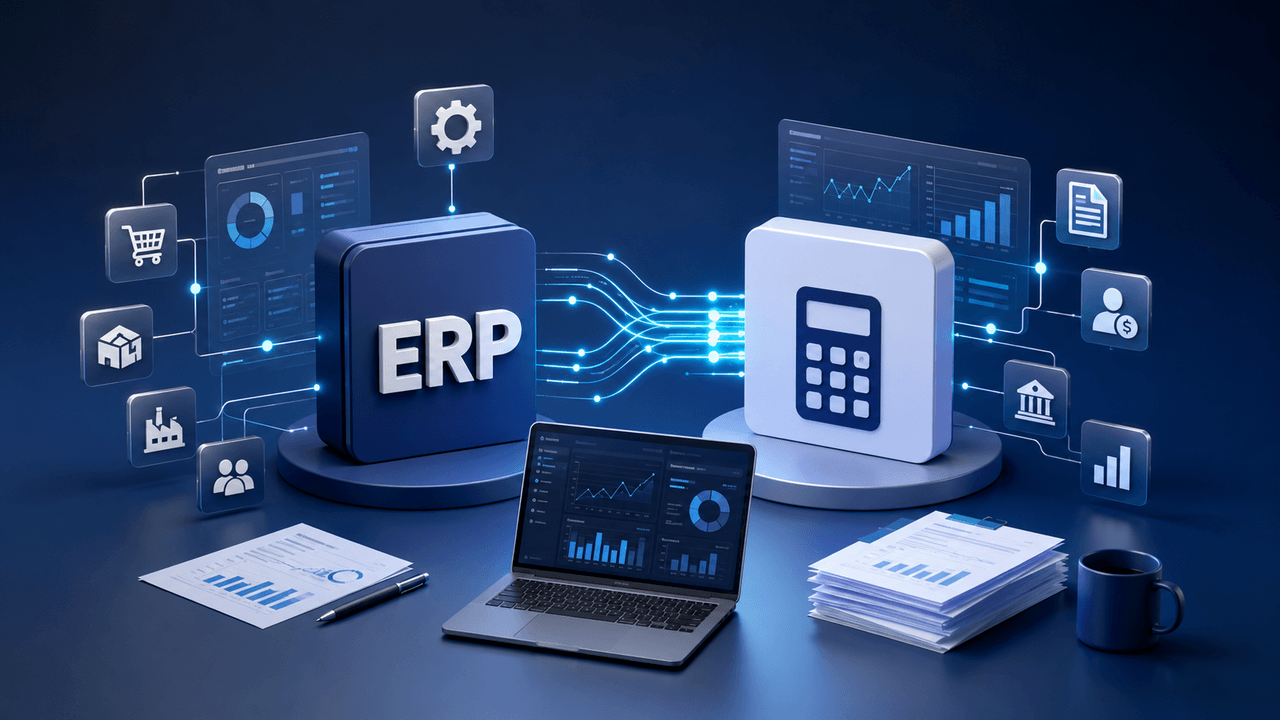
As digital transformation continues to accelerate, businesses are increasingly adopting various software solutions to manage their operations more efficiently. In particular, ERP (Enterprise Resource Planning) and accounting software help organizations monitor and manage their financial processes and day-to-day operations in a structured and organized manner. However, when these two systems operate independently, they can lead to time-consuming manual tasks and inconsistencies in business data.
This is where data integration between ERP and accounting software becomes a valuable asset. By automatically synchronizing information between systems, businesses can streamline their workflows, minimize manual errors, and significantly improve overall operational efficiency.
What Is ERP Software?
ERP (Enterprise Resource Planning) is an enterprise software system that enables businesses to manage all their core processes through a single, centralized platform.
ERP solutions typically cover the following areas:
Sales management
Procurement processes
Inventory and warehouse management
Production planning
Human resources
Finance and accounting
Reporting and analytics
By bringing data from different departments together in one place, ERP systems provide businesses with greater visibility and support more informed, data-driven decision-making.
What Is Accounting Software?
Accounting software is designed to simplify and streamline a business's day-to-day financial operations.
With accounting software, businesses can efficiently manage:
Customer and supplier account tracking
Income and expense management
Payment collection and payment processing
Invoice creation
Inventory transactions
Cash and bank account management
For small and medium-sized businesses (SMEs) in particular, accounting software plays a vital role in maintaining organized financial records and ensuring that daily financial processes run smoothly.
Why Should ERP and Accounting Software Be Integrated?
Many businesses use ERP and accounting software as separate systems. As a result, the same data often needs to be entered multiple times.
For example, if a sales order is recorded in the ERP system and then has to be manually entered into the accounting software as well, it can lead to:
Time-consuming manual work
A higher risk of data entry errors
Inconsistent records across different systems
Increased workload for employees
Data integration eliminates these issues by automating the entire process, allowing information to flow seamlessly between systems.
Benefits of Data Integration
1. Eliminates Manual Data Entry
Instead of entering the same information into multiple systems, data is automatically synchronized. This enables employees to focus on higher-value tasks rather than repetitive data entry.
2. Reduces Errors
Manual data entry often results in incorrect figures, missing information, or inaccurate records. With data integration, information is transferred directly between systems, significantly reducing the risk of human error.
3. Provides Real-Time Data Synchronization
As soon as a sale is completed:
Inventory levels can be updated automatically.
Customer or supplier account balances can be adjusted.
Financial records can be generated instantly.
Management reports can be updated in real time.
This gives decision-makers access to accurate and up-to-date information whenever they need it.
4. Accelerates Business Processes
When processes from order creation to invoicing are automated, employees spend less time on routine tasks, and businesses can deliver faster, more efficient service to their customers.
5. Improves Reporting Accuracy
When different systems contain inconsistent data, reports become unreliable. With integrated systems, all information is synchronized from a single source, resulting in more accurate financial analyses and management reports.
Challenges of Operating Without Data Integration
Businesses that lack data integration frequently encounter the following issues:
Duplicate invoice entries
Incorrect inventory levels
Customer and supplier account discrepancies
Missing financial records
Outdated reports
Increased employee workload
Higher operational costs
Over time, these challenges can reduce operational efficiency, impact decision-making, and negatively affect customer satisfaction.
The Importance of API Integrations
In modern software ecosystems, data exchange is primarily enabled through API (Application Programming Interface) technology.
API integrations allow systems such as:
E-commerce platforms
ERP systems
Accounting software
Virtual POS solutions
Shipping and logistics providers
CRM systems
to communicate with one another securely and efficiently. This interconnected structure enables businesses to manage data from multiple platforms through a centralized system, improving operational efficiency and ensuring consistent information across all business processes.
Which Businesses Benefit from Data Integration?
Data integration is not only beneficial for large enterprises but also for businesses of all sizes that aim to grow and improve their operational efficiency.
It is particularly valuable for:
Retail businesses
Wholesalers
Manufacturing companies
E-commerce businesses
Distributors
Companies operating through dealer or franchise networks
Service-based businesses
By integrating their systems, these organizations can streamline operations, reduce manual workloads, improve data accuracy, and make faster, more informed business decisions.
Integrated Business Processes with Bayiloji
As businesses grow, the number of software solutions they rely on also increases. Ensuring seamless communication between these systems is essential for maintaining operational efficiency and supporting sustainable growth.
Bayiloji helps businesses unify their operations by enabling smooth data flow between ERP systems, accounting software, inventory management, order processing, and other business applications. By connecting these systems, businesses can reduce manual data entry, accelerate workflows, and gain access to reliable, up-to-date information that supports better decision-making.
Conclusion
Integrating ERP and accounting software is a crucial step in any organization's digital transformation journey. Automated data synchronization saves time, minimizes human error, enhances reporting accuracy, and improves overall operational efficiency.
In today's highly competitive business environment, solutions that enable seamless data exchange between different systems provide organizations with a significant competitive advantage. By adopting integrated software infrastructure, businesses can not only optimize their existing processes but also build a stronger foundation for future growth and long-term success.
Subscribe to Bayiloji
Don't miss updates, tips and special deals in the world of dealership.